2012 ASCO Annual Meeting-Chicago/USA

2012 ASCO Annual Meeting-Chicago/USA
Award IDEA recipients and the chairman of IDEA program, ASCO

samedi 24 octobre 2009

LIVESTRONG DAY IN GOMA/DRC, October 2, 2009


0. Content of report
- Introduction
- Objectives the event
- Organization background
- Progress of the event
- Participants
- Evaluation of the event
- Questions asked and recommendations
- Conclusions

1. Introduction

On October 2nd, 2009, AGIR ENSEMBLE, planned to organize a Raising Awareness Session (RAS) on cancer with a group of 15 couples in the city of Goma. At first, we had planned a scientific debate with doctors and nurses of the city of Goma, but considering the not availability of doctors for a working day (Friday), we saw have changed the target of our meeting. So we invited 15 couples of parents to attend the meeting this to mean a total of 30 persons among whom 15 men and 15 women.

This session took place normally as expected supporting the activities of Lance Armstrong foundation the day of anniversary of the diagnosis of Lance Armstrong and the month of raising awareness on the breast cancer, the month of October.
The duration of the event was 3 hours from 1:00 pm to 4:00 pm.

2. Objective of the session

On October 2 of every year is a historic date for LAF and for Lance Armstrong and finally for the whole world generally.
October is also a month of raising awareness on breast cancer. So AGIR ENSEMBLE wanted to join other partners of the world acting in the FIGHT AGAINST CANCER and supporting activities of LAF to make our contribution and commitment in spreading information which can save lives and maintain the health of population in the world.
For this session, AGIR ENSEMBLE settled following goals:
- Bring together a group of 30 relatives (parents) gathered in 15 couples who can receive the message that the cancer is a global priority of public health,
- To teach to the group how to proceed to the Breast Self Examination (BSE) for early detection and at the end of the session at least 95 % of participants will know correctly this technic and the importance of the BSE.

3. Context of organization

Considering the financial difficulty, the event was held in one of the classrooms of Mont Goma Institute just after the courses from 1:00 pm till 4:20 pm. The event has been attended by 23 persons among whom 6 females and 17males. We have made T-SHIRTS (in yellow) for the participants.

4. Progress of the event

The event took place around these subjects:
"The cancer, a global priority ", "The Prevention of the breast cancer ", “Integrate good food customs for the prevention of the cancer ". The moderator of the session was Mr Alphonse KAVWIRWA, president of the board of AGIR ENSEMBLE and the organizing committee was composed by Mr. Paul LUGHEMBE and Mr Jonathan VALIHANO.
The main speaker of the session was Dr Mateus KAMBALE SAHANI, the director of the Health Department of AGIR ENSEMBLE.
The session began with the allocution of the president of AGIR ENSEMBLE, Mr Alphonse KAVWIRWA who has welcomed all participants to the session of the day and presented the missions of AGIR ENSEMBLE.
Then Dr Mateus SAHANI began explaining the background of the event and presented the relevance of the LIVESTRONG Day. “October 2 is the date that Lance Armstrong got his diagnosis of cancer and he begun the battle for life and founder the Lance Armstrong Foundation. It’s a historical date celebrated by LAF and its partners worldwide. Our event is one of thousands of events around the globe. This year there are events on every continent (even Antarctica!) and in all 50 states in the U.S. LIVESTRONG Day is a day to celebrate, it is a day to educate and it is a day to advocate. But most importantly, it is the day our collective voice will show the world that cancer must be a global priority” he said.
After this, the speaker began the session “Cancer, a global priority” in which he gave the place held by cancer as a big public health threat and the cancer burden worldwide. “Cancer will be soon, in some year, the leading cause of death worldwide. We know that cancer kills 7.9 million people each year and if nothing is done by now cancer will kill 11.5 million of people. Every one may act by now if you want to save the 28 million of people living with cancer in the world and if you want to address the cancer burden worldwide. The voice of each one is needed for the fight”, he said.
The speaker explained also the role of bad habits in developing countries, the habits of not consulting early when people are sick. He asked to people who were listened to him to abandon these bag habits to help the world becoming “a world without cancer”. This will allows early detection and screening for cervical cancer and breast cancer.
As it’s the month of October, a session on “Prevention of Breast cancer and early detection” has been developed. The speaker gave more detailed explanation of the method of Breast Self Examination (BSE), its advantages, technic and warning signs, etc. Some factors of risk for breast cancer have been given and now the speaker concluded the session by showing some pictures of sicks treated surgically for breast cancer and who developed metastasis and are taking palliative care.
Then some questions were asked and answered by the speaker. All participants were interested by the sessions of the day and 20 questions have been received. Almost all questions were answered with satisfaction of the attendees except one which was: a woman with breast cancer can continue breasting the baby with sick breast? Now the speaker proceeded to an exercise of question-answer to the public to evaluate the degree of understanding of the lesson by participants especially concerning the technic of Breast Self Examination (BSE) and this was satisfactory.
After this a cocktail was offered to participants and during the cocktail a module on “Healthy eating and energetic balance” was developed by Mr. Alphonse KAVWIRWA. A sery of 3 questions were asked and answered.
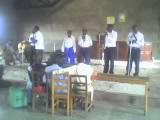
During the session, 2 walking people passed in front of the meeting room and were also interested by our message and now the president asked them to join us in the room because the voice and action of every one are needed. See 2 gentle men in black T-SHIRTS on photos.
5. Participants
In total 23 people attend the meeting among whom 6 females and 17 males and were interested by the activities of the day.
6. Evaluation of the session.
We expected 30 people for the meeting and brought together 23. This objective was reached in 76.66%. The second objective was reached in 100%. In all our performance was 88.33%. The main barriers for us to reach our maximum of goals were the background of the organization of the event, the moment and missing financial support. Doctors didn’t find time to join us because of their job at hospitals and we didn’t be able to organize transport for participants.
7. Questions and recommendations
Questions
- What is cancer ?
- What is the cause of cancer?
- Is there a link between sexual course and the disease? Does exist a sexual transmission of cancer?
- A woman with breast cancer can continue feeding her baby with the sick breast? Is there a transmission to child?
- From when are statistics of 7.9 millions of deaths/year by cancer and 5.4 millions of deaths/year by tobacco?
- A person with cancer can still alive how many years?
- Where do you place hard work of teachers? Can this replace physical effort to address risk of cancer?
- With physical activities, how can some one know that he is making balance between eating and spending energy?
- How to get medicines of cancer in our community?
- Test VIH, TB, etc. exist; is there a test for cancer?
- What are symptoms of cancer?
- What to do to avoid overweight for children?
- What to say to a sick of cancer considering that medicines are not available in our community?
- Can a man proceed to the BSE of his wife?
- Can the breast feeding influence the volume of the breasts? If a child uses preferably one breast than another, this can create difference between the 2 breasts?
- There is a woman without child who presents bleeding of the nipple; this can be a sign of breast cancer?
- Is there a link between medical family planning and cancer?
- Prostate cancer can be linked to sexual courses?
- What type of cancer is more fatal than other?

Recommendations
At the end of the event, participants have recommended that:
- It is important to organize more events like this one to allow spreading the message that can save lives.
- To choose a place and a moment which allow more people to attend the event for the next time.
- Organize such event for all NGO which are members of RACID Network to permit them understanding the problem.
- Choose a moment for women and young girls to explain them the modes of prevention of cervical cancer and screening.
- We would like that Lance Armstrong Foundation play the role of funds mobilizator to allow support of such events for a real success.
8. Conclusions
Generally the activities of the day were well realized and it was a real success even if there were some difficulties. All was done as planed and our goals were reached. Participants were satisfied by the event and the message was new for almost 95% of them. They wished us to invite more people for the next occasion.
Goma, October 7th, 2009.
Dr Mateus KAMBALE SAHANI
AGIR ENSEMBLE/DRC.

AGIR ENSEMBLE joined LIVESTRONG Global Cancer Summit to make cancer a global priority

AGIR ENSEMBLE JOINED THE LIVESTRONG Global Cancer Summit to make cancer a global health priority.

Summit Inspires New Resolve to Fight World Cancer Problems.

28 September 2009,

Dublin – AGIR ENSEMBLE/GOMA-DRC joined the Lance Armstrong Foundation (LAF) and other key international health organizations from August 24-26 at the Irish capital for the first LIVESTRONG Global Cancer Summit, designed to raise awareness and mobilize support to fight the growing global cancer crisis.
LIVESTRONG is a valuable opportunity to raise international public awareness of the cancer epidemic, especially in developing countries, and we are pleased to have taken part in this first Summit.
LIVESTRONG attracted more than 500 participants from some 65 countries around the world. They included world leaders and policymakers, NGOs, business executives, cancer professionals and advocates.
IAEA has a mission to bring more attention and resources to the global cancer fight through its Programme of Action for Cancer Therapy (PACT). PACT, a LAF partner, is the IAEA's umbrella programme for cancer control efforts in developing countries. But till there nothing has been done by IAEA in DRC, a country which has 60,000,000 people and without any program of fight against cancer.
“When people leave here, we know that change will be effected and that lives will be affected. We know that lives will be saved because of the programs that are created and dreamed up here,” said summit organizer Lance Armstrong, at the opening of LIVESTRONG.
Seven times winner of the world renowned Tour de France bicycle race and founder of LAF, Armstrong is a survivor of a severe testicular cancer, diagnosed in 1996, which later metastasized to his lungs and brain.
On the first day of the event, Werner Burkart joined a panel of experts to discuss the Global Impact of Cancer. Chaired by CNN's medical correspondent Sanjay Gupta, the panel included John Seffrin, CEO of the American Cancer Society (ACS), Christopher Wild, Director of the International Agency for Research on Cancer (IARC) and Lynn Faulds-Wood, President of the European Cancer Patient Coalition (ECPC).
The IAEA provides developing countries with technical expertise and equipment related to radiation medicine – a vital component in the treatment of cancer. The IAEA is working in partnership with the global health leader, the World Health Organization (WHO) and other international partners to bring more attention and resources to the global cancer fight. Our government must do more efforts and show its commitment for our population to benefit this technical expertise and equipment.
Speaking after the event, Burkart said: “The IAEA, after decades of experience helping developing countries cope with the burden of cancer, has been advocating for cancer to be added to the global health agenda, and ultimately become part of the Millennium Development Goals. The Summit was an important opportunity to make the case, together with our partners, on an international stage.”
A highlight of the Summit's second day was the presentation of a special report on the economics of cancer prepared by the Economist Intelligence Unit for LAF with support from the ACS. Entitled Breakaway: The global burden of cancer – challenges and opportunities, the report estimates that there will be 12.9 million new cancer cases globally this year alone, representing an immense economic burden of US$305 billion.
Commenting on the report, Dr Ala Alwan, the World Health Organization's Assistant Director-General for Non communicable Diseases and Mental Health, said: “These new data delineate a stark trajectory for cancer if immediate action is not taken. The rise of cancer creates an enormous burden on health systems around the world. But this is not just a health challenge; it undermines economic growth and acts as a chronic poverty trap for the poorest countries.”
And it is in developing countries that the cancer burden shows the steepest increase. Evidence shows that nearly half of all new cancer cases this year will be in low- and middle-income countries, and that figure is likely to increase dramatically over the next decade to as much as 75%. Yet currently only five percent of global resources for cancer are spent in the world's poorest nations.
Among the most important outcomes of the Summit were the need to make cancer a global priority, the need for greater financial investment in cancer, and the need for assessment of countries' national cancer control plans.
The main goal of our government could be the building of international partnerships with IAEA and others partners to help our country establishing healthcare systems that provide early detection and timely and effective treatment for all cancer patients everywhere in the country and to concept a National Cancer Control Plan (NCCP).
AGIR ENSEMBLE would like to alert all of conscientious leaders in DRC especially doctors and all health care professionals to put cancer on their agenda of priority because if leaders as us don’t speak about cancer, other people don’t pay attention on it.
By now it is known that 30% of cancers are preventable and 30% other are curable. We may prevent the preventable and cure the curable but this demands our commitment to act and raise awareness people and to educate policy makers to make cancer a global priority.

Thank you.
Dr Mateus K. SAHANI, AGIR ENSEMBLE.

lundi 10 août 2009

Un cas de tumeur du poumon


Description et point de vue de Dr Mateus Kambale Sahani/RDC
Cas clinique: il s'agit d'un malade de sexe masculin, âgé de 48ans, HIV+ suivi régulièrement au programme de prise en charge du VIH avec CD4 de 650, n'ayant pas encore commencé le traitement ARV. Il se présente avec une toux qui vient de durer 4 semaines avec sudation nocturne, difficulté respiratoire parfois, marié et cultivateur.
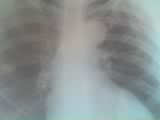
La NFS est normale avec une VS de 37 mm/1ere h. Le crachat examiné au Ziehl est 3X Négatif et cela à 2 séries successives. Ceci nous a poussé à demander la Radiographie du thorax dont l'image du cliché se trouve en pièce jointe (malheureusement le profil n'a pas été fait, je pense pour problème de capacité technique du radiologue). Sur le cliché, tout le poumon droit n'existe pas, on ne voit pas la silhouette cardiaque mais à l'auscultation on écoute les bruits du coeur, on voit une coudure de la colonne cervicale. Nous l'avons envoyé a l'Hôpital universitaire CHUK ou la ponction thoracique n'a amené qu'une très petite quantité de liquide qui ne pouvait vraiment pas justifier toute cette opacité. Le CHUK l'a aussi envoyé au "King Fayçal Hospital" et de la, le malade n'ayant pas de moyens financiers, on l'a seulement aidé à faire le scanner qui a révélé que le poumon droit est collabé et ils n'ont pas été à mesure de déterminer la cause du collapsus. Le malade m'est revenu sans aucune explication après avoir reçu une prescription du Bactim 960mg.
Moi, je pense qu'il s'agirait d'une tumeur de la grosse bronche droite qui a empêchée l'air d'atteindre les alvéoles et qui est à l'origine de l'atélectasie mais je me demande comment le scanner ne pouvait pas dire grand chose? C'est cela qui fait perdurer la confusion.
Pour le moment ce malade présente une dyspnée même au moindre effort, même à la simple marche de quelques mètres.

Point de vue de Dr Etienne Leroy Terquem, Hôpital de Meulan/France
En ce qui concerne ce cas, les choses me paraissent assez simples. Je suis tout à fait d'accord avec ton analyse: Il s'agit bien d'une atélectasie pulmonaire droite complète, en rapport avec une obstruction de la bronche souche droite, soit par une lésion intra bronchique vraisemblablement tumorale ou une compression extrinsèque sûrement aussi d'origine tumorale. Le fait que le scanner n'a pas permis d'aller plus loin dans le diagnostic est un peu étonnant, soit qu'il ait été mal interprété, ou alors réalisé sans injection de produit de contraste. Dans ce dernier cas, il est difficile de distinguer une lésion tumorale des opacités vasculaires normales du médiastin et de l'opacité liée à l'atélectasie. L'injection de produit de contraste permet de distinguer clairement les densités vasculaires médiastinales et les autres densités tissulaires (poumon atelectasique, tissu tumoral).
Je connais bien un radiologue de Fayçal qui s'appelle Etienne Uwimana, très compétent et à qui tu pourrais montrer les clichés de ma part si tu en as l'occasion.
La solution serait de réaliser une endoscopie bronchique mais je sais qu'elles ne sont réalisables que très difficilement au Rwanda.

Conclusion : Tumeur bronchique compliquée d’atélectasie complète du poumon droit.

Quel traitement a mettre en place pour ce malade ?

dimanche 2 août 2009

Lymphome de Burkitt detecte chez une PVV


Dans nos régions des pays en voie de développement, les gens font moins attention à leur état de santé.
Le Lymphome étant l'une des tumeurs liées à l'infection à VIH, a été détecté chez une personne vivant avec le HIV et cela lors de son test de VIH après sensibilisation (Programme PIT).

Cette personne venait de faire 1 année avec cette tumeur sans être motivée à se faire soigner et après investigations, la tumeur était de consistance dure, avec peu de douleur et de sensibilité adhérant aux plans superficiel et profond.
En conclusion, la tumeur était au stade avancé.

Le constat est que les malades avec tumeur arrivent à l’hôpital toujours au stade avancé (à 95%) et cela par manque d’information suffisante. Cela revient à dire que les professionnels de santé ont une part de responsabilité du fait de ne pas diffuser suffisamment l’information à la population.
Il est vrai que nos populations ont besoin d’être éduquées tant sur le tabac et aussi sur le cancer. On n’oublie pas que le cancer tue 7.9 millions de personnes chaque année et qu’il y a 28 millions de personnes vivant avec le cancer dans le monde.
Si nous, professionnels de santé, ne parlons suffisamment du cancer, d’autres personnes n’en ferons pas attention.

Le cancer est aujourd’hui un grand problème de santé publique, il faut donc que chacun l’insère dans son agenda des problèmes à combattre.

Merci,

Dr Mateus Kambale Sahani
AGIR ENSEMBLE/DRC.

vendredi 31 juillet 2009

A discussion of experts on cancer registry worldwide


Dear All,

The mounth of July was a mounth of the second theme of discussion of professionals involved in cancer control with experts through Global Cancer Control Community of UICC. The discussion focuses on the target 2 of the World Cancer Declaration and consist to answering to the following questions:

1. Do you have a cancer registry system in your country? If so, please describe. If not, what are the main obstacles in your country that hamper development of a national cancer registry?
2. Does your country rely on a population-based or representative cancer registry?
3. If possible, do you know approximately what percentage of the population is covered by the cancer registry?
4. Which institutions are responsible for cancer data collection - government agencies or others?
5. How can health care professionals lobby government and health officials to invest in cancer registry development?

Here answers from DRC:
1.A cancer registry exist in DRC but is not well structured and organized because each hospital has its own data and these data are mechanically registered. Some institutions don't have computer and even those who have computer don't use it for registry. This because more professionals don't have sufficient skills for database system.
2.In the country there is no oncology service or unit.Cancer sicks are treated in others service as internal medicine department, surgery department, pediatric department, gynecologic department. This is done locally in each hospital but there is also a problem of diagnosis.For more of cases there is no certainty of diagnosis because of missing the appropriate materials for confirmation. All these cases are not registered.
3.The percentage covered by the cancer registry is not known in DRC.
4.Each institution has its own database but all report to the provincial inspection of health. But in all the reports there is not more information about cancer.
5.In DRC, the lobbing to be effective may be done by NGO with health professional. It is good that NGO organizes training in cancer and implement some programs in hospitals. But this demand more financial support.

Thank you,

Dr Mateus kambale Sahani/DRC-AGIR ENSEMBLE.

mardi 28 juillet 2009

L'usage de la drogue par la jeunesse dans la ville de Goma

AGIR ENSEMBLE a publie un article sur l'usage de la drogue par la jeunesse de la ville de Goma depuis quelques jours. Cet article peut etre commande gratuitement par email en contactant Mr Alphonse Kavwirwa a l'addresse suivante: aensemble@yahoo.fr

Merci,

AGIR ENSEMBLE.

Make more dedications to sign the world cancer declaration


I just dedicated a page to my partner Italo Goyzueta at
LIVESTRONG Action.

This page is a part of the world's largest dedication book that LIVESTRONG
Action will use to pressure world leaders to do more to fight cancer. Can you
add your name to my dedication page? It'll only take a second, and you can
help me reach my target of 25 dedications. Please click here, it only takes a
second:

http://www.livestrongaction.org/dedication/dr-mateus-kambale-sahani-3 [1]

Right now, Lance Armstrong is dedicating his ride in the Tour de France to
the fight against cancer. And after the race, he'll send this dedication
book - with your signature - to world leaders and pressure them to
make cancer a priority in their own countries. It's our best chance to push
for better treatment, more funding for cancer research and access to care for
everyone around the world.

But if people like us don't stand up, these leaders won't pay attention.

Will you check out my dedication page? Italo Goyzueta inspired me
to take action - hopefully they'll inspire you to do the same:

http://www.livestrongaction.org/dedication/dr-mateus-kambale-sahani-3 [2]

Dr Mateus Kambale Sahani.